Sunday, 4 April 2010

My day out in Pompey

The city of Portsmouth is built on an island -- Portsea Island, in fact -- and here we are, looking across Portsea Creek towards Portsmouth:


As you can see from this next photo (Portsmouth is on the right bank, mainland Hampshire on the left), no-one cared very much for Portsea Creek, so it now forms the foundations for the M27 south coast motorway:


Portsmouth is, of course, the headquarters of the Royal Navy and it is very much an Admiralty town. For years, their Lordships refused permission for the railway to enter Portsmouth since, by doing so, it would have to smash through the defensive wall built along Portsea Creek to protect the town's northern flank.


Eventually, of course, commerce won, and today the railway goes right through the city (stations at Fratton, Hilsea, Portsmouth & Southsea and Portsmouth Harbour), ending up here, right on the waterfront:


Unlike most similar cities Portsmouth lacks a single, grand central terminus. Although Portsmouth Harbour is the end of the line, Portsmouth & Southsea is probably the main station, such as it is:


The station has "high level" platforms -- two tracks that run through the station and on to the Harbour -- all other south-bound trains terminate at the low level:


Although the high level isn't much to look at (there are more magnificent stations on the Docklands Light Railway...), the view from the end of the platforms shows you both the gradient of the track and this rather fine view of 4-aspect signals, each in sequence:


A lot of Portsmouth consists of Georgian architecture, from its hey-day, really. It has economically stagnated over the years since then, the gushing flood of defence spending no longer being spent in ways that are to the city's advantage:


But there used to be a lot of civic pride in Portsmouth:


And the Victorians and Edwardians added their fair share of civic pomp:


It always pays to look up at this type of architecture:


There are usually little pavilions-in-the-sky, or perky pediments in abundance.


Which is just as well because often the whole composition can look a bit underwhelming (too bulky to allow you to concentrate, but not significant enough in its own right, if you know what I mean):


And there's usually a sculpture or two to provide distraction:


In a city like this, of course, lions are two-a-penny:


And obviously this is not a particularly friendly city for republicans like me:


Indeed, there are some not-so-subtle signs around which leave you in no doubt about the city's affiliations:


Although maybe I'm being over-sensitive:


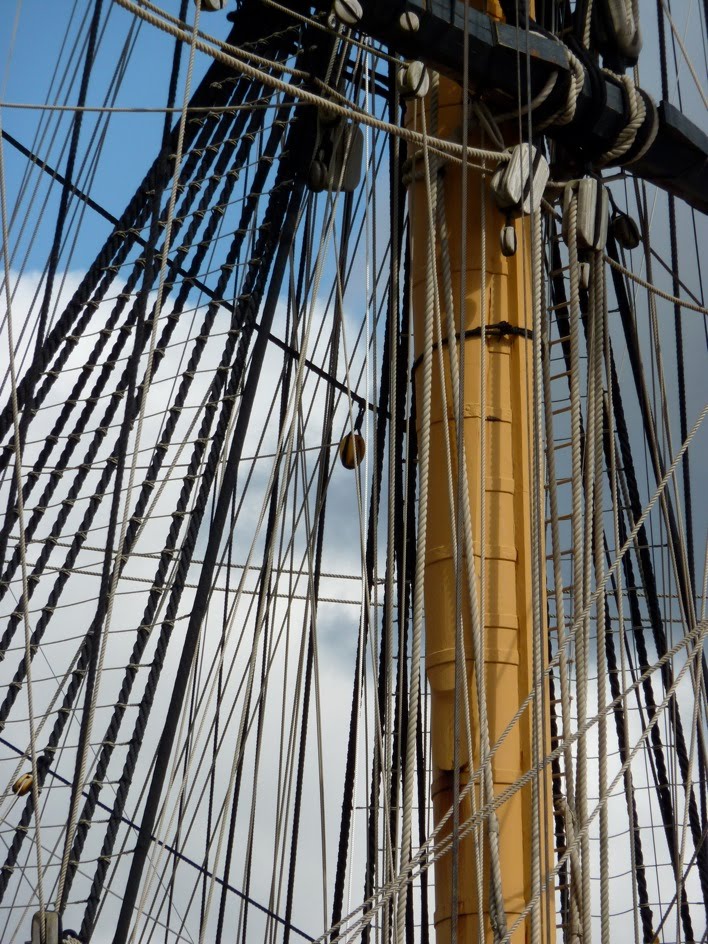
No tour of Portsmouth would be complete without paying homage to Horatio Nelson at his flagship, HMS Victory. Apparently a rather unprepossessing man, very short, with bits shot off here and there, his hair in a long waxed knot, Nelson is one of England's genuine heroes -- and a delightfully flawed human one, at that.


A fellow Norfolkman, Nelson had the bloody-minded stubborness and native cunning that seem to be frequent in those parts.


I'm no military expert but, if for nothing else, I admire him for his willful act of defiance against his cautious commander, Admiral Sir Hyde Parker. He was ordered by Parker to withdraw from confrontation with the Danish Navy, the order conveyed by signal flags...


... An officer on Nelson's ship pointed out that an order had been given, at which Nelson famously clapped his telescope to his blind right eye and dismissively said: "I see no signal".

While lots of lovely Georgian architecture remains, the city was devastated in Second World War bombing with the unfortunate consequence that lots of cheap and not very good architecture was slung-up in the 50s and 60s. It can have an air of desolation about it:


Although some of the 50s stuff, in particular, can be almost jaunty:


The same can't really be said of the 70s stuff:


Still, at least the infamous Brutalist Tricorn Centre has now been demolished.

I think that's probably enough about Portsmouth for now.

Monitor

This is a nifty digital recreation of a particularly odd-looking naval vessel -- the pioneer Monitor-type (called, unsurprisingly, the USS Monitor), which launched in 1862.


It was effectively a floating gun turret, iron-clad and with very little draught to enable it to steam far up-river. The gun was intended for shore bombardment, or for destroying other iron-clads (the iron-clad war-ship was the brand-new super-weapon of its day).


It famously participated in the first-ever battle between two iron-clads, its opponent being the CSS Virginia (actually a captured conventional ship called the Merrimack, that was rebuilt as an iron-clad). The battle was a draw.


But the USS Monitor launched a whole new class of ship -- sitting incredibly low in the water (to minimise the target for the enemy), even though it had a shallow draught (to enable estuarine or even riverine operations), and usually punching massively disproportionately guns designed for bombardment (which benefited from the more stable platform provided by the low centre of gravity).


These were the classic imperial gun-boats.


It's therefore unsurprising that the Royal Navy got in on the act, and that was a 1918 photo of the prosaically-named "HMS Monitor M33", sometimes known as HMS Minerva.


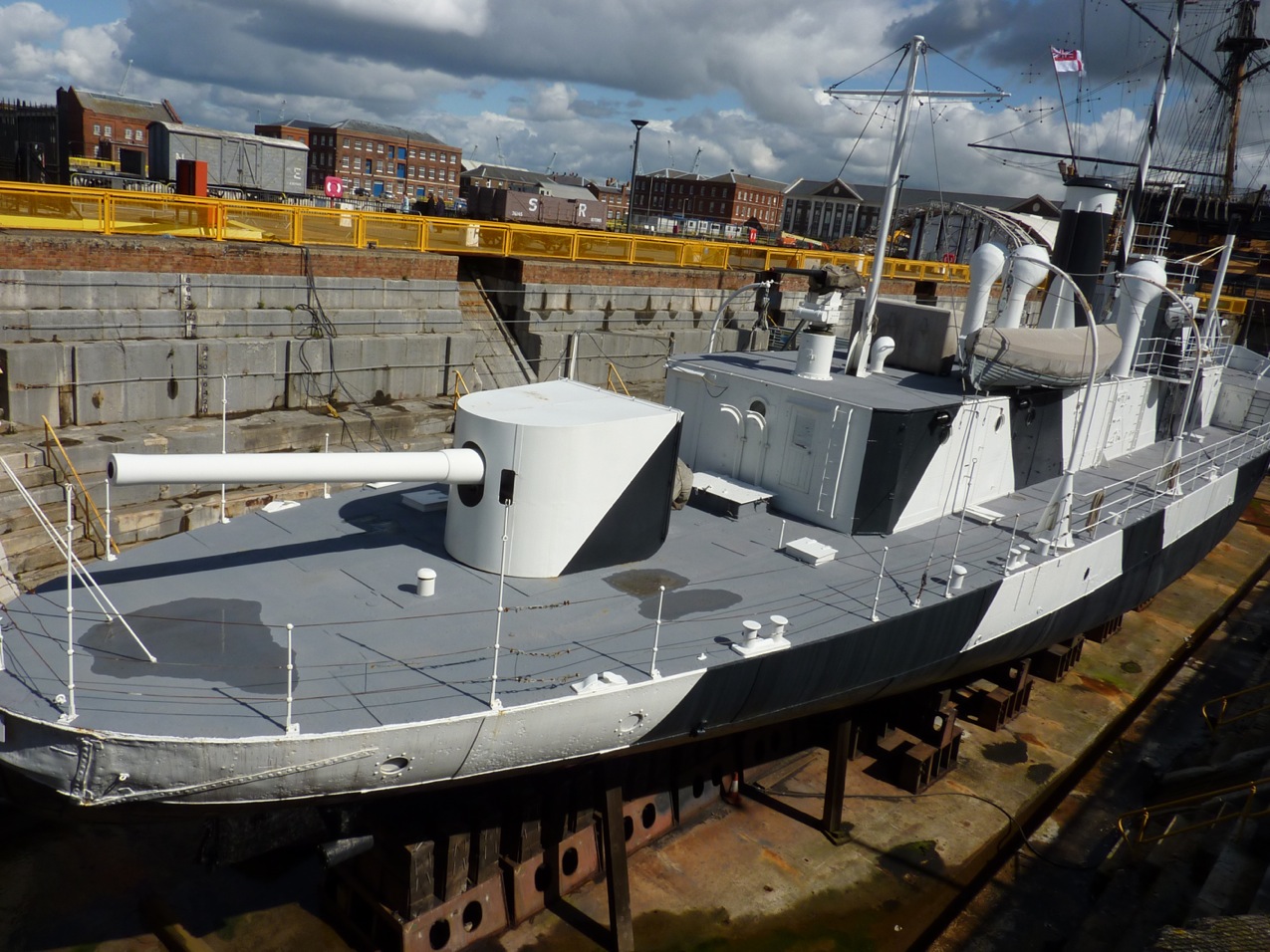
Prosaic name or not, M33 was a lucky ship: it's one of only two First World War Royal Navy vessels to survive, and it's currently being restored by Hampshire County Council.


Here it is, sitting in a dry dock in Portsmouth, wearing its dazzle camouflage.


It has the shallow draught, the low superstructure, a pair of massive guns (plus a few others for defensive purposes), and giant search-lights. And not much else: Monitors are very sharply-focused ships.


They fell out of favour after the Second World War -- the end of the old-style imperial adventures, as well as changes in technology, meant they were too specialist to justify their existence. Although they enjoyed a brief revival during America's imperialist adventure in Vietnam:


That's a far cry from one the US's most feted Monitor design -- USS Puritan:


But these things go in circles, and the latest US Navy proposals are for a new type of ship that specialises in littoral work, and for destroyers with a major focus on shore bombardment:


That looks like a 21st-century (imperial) Monitor to me.

Saturday, 3 April 2010

So, so tall

My favourite pornographer has been at it again, this time capturing a rather lanky-looking tattoo artist.


The model is, apparently, extremely tall, and he also did all his own tattoos -- he was practising, before he went professional.


The fact that he practised on his own cock suggests a degree of dedication I find unimaginable.


But that hard stare suggests he is a man of determination: he apparently described tattooing his cock as the single most painful experience of his life.


Perhaps that's why he put skulls on it, although I am a tad concerned by the Freudian symbolism behind it all. And let's not even get started on a Jungian interpretation.


I am not a huge fan of tattoos, possibly for the very same reason that some people love them: that they provide permanent clothing, taking away even the possibility of naked intimacy. But I might make an exception for this guy. Though I'd probably be quite scared...

Lightweight

Even before the start of the Second World War, it was becoming obvious that the economics of Britain's railway system didn't add up: costs were high, staffing levels had been set in an era when labour was cheap, and both freight and passengers were haemorrhaging onto the roads.


Despite experiments stretching back to the late 1920s, it was only in the early 1950s that diesel multiple units were taken seriously, and the nationalised British Railways in 1954 launched the "Derby Lightweight" -- so-called because of the extensive use of light alloys in its construction.


A hundred units were built (more than 200 individual cars), most as two-car sets but with a handful of four-car units.


They were allocated to areas with extensive branchline systems, where a diesel multiple unit enabled on-train staffing to be reduced by 35%, and depot staffing by equally significant amounts (it is no coincidence that much of the publicity material around their launch emphasises their cleanliness, and they required much less maintenance than a steam engine).


East Anglia took a very significant number, and these units proved successful on both ex-Great Eastern and ex-Midland & Great Northern lines. As well as operating costs going down, passenger numbers very significantly increased.


Here a delightful Derby Lightweight speeds along the Yarmouth-Lowestoft line, its yellow "speed whiskers" setting off the Brunswick green livery.


The DMU experiment was judged a resounding success, and British Railways ordered vast quantities of new machines using the experience gained from the Derby Lightweights.


Ironically, the Derby Lightweights were retired early -- they were not compatible with the new fleets of DMUs and they had largely disappeared by the late-1960s.


That soaring cathedral-like window at the front was never repeated (and careful study of the photos shows that during their lives most of them had "strengthening bars" added). But the later DMUs repeated the design feature where passengers could look out at the tracks ahead -- sitting immediately behind the driver was especially prized.